
One Journey, Multiple Voices: David Ellenhorn’s Perspective
June 17, 2026
New JPI Grants Launch to Support Jewish Professionals in Washington State
August 27, 2026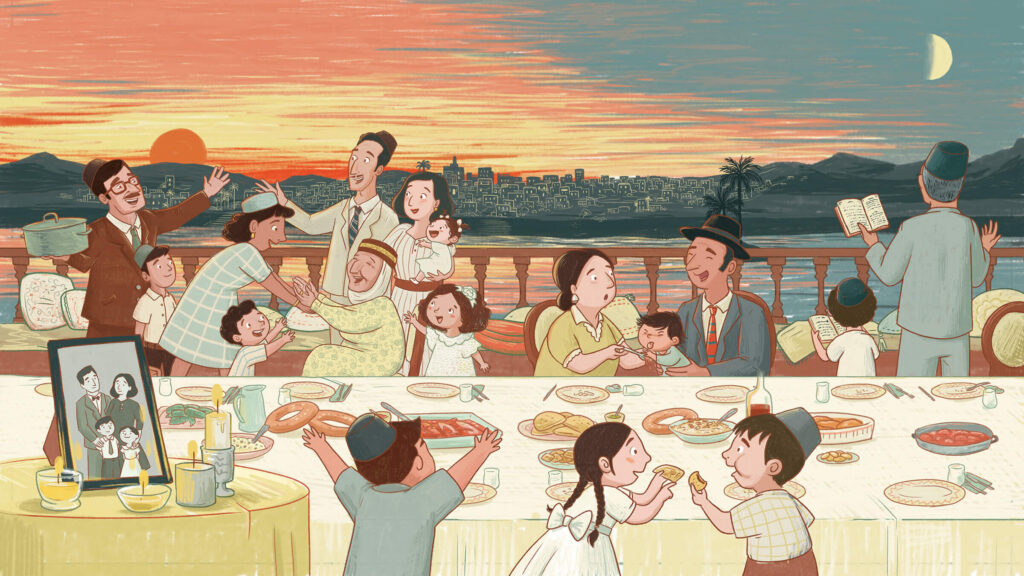
The iconic Jewish children’s book publisher is boosting authors who want to publish Sephardic, Mizrahi and Ethiopian tales for kids
The Samis Foundation is a seed-funder of the PJ Library Sephardic Stories Initiative.
By Simone Saidmehr, July 28, 2026
In 1940s Baghdad, a little girl named Na’ima tries desperately to stay awake all night for Shavuot. In wartime Libya, a young boy embarks on a supernatural quest to find a lost city. In 19th-century Morocco, a father’s frustration with his son’s teacher leads him to a rabbinical court.
Until recently, none of those stories would have been likely candidates for mainstream American Jewish children’s books. Now, they are among the first titles slated for publication through PJ Library’s Sephardic Stories Initiative, a fellowship launched in 2024 to support authors writing tales that reflect Sephardic, Mizrahi and Ethiopian Jewish traditions.
For more than two decades, PJ Library has mailed free Jewish children’s books to families around the world. Today, it distributes roughly 670,000 books monthly in more than 40 countries. According to Alisa Koyrakh, the organization’s director of books, those stories have historically reflected a familiar slice of Jewish life.
“There are just a lot of Ashkenormative stories out there—a lot of stories about Yiddish, the Lower East Side and immigration from Eastern Europe,” Koyrakh said. “Those are all really important stories. But we saw gaps. It was kind of obvious.”
The Sephardic Stories Initiative intends to fill those gaps, bringing together Sephardic and Mizrahi writers for a year of workshops, editorial mentorship and critique from their peers.
Arnon Z. Shorr, whose first foray into children’s literature was a fiction book about Ladino-speaking Jewish pirates (yes, those were actually a thing), described his forthcoming graphic novel, Pedahzur and the Quest for the Hidden City, as a supernatural adventure set in Libya in the mid-1940s.
Knowing 1940s Libya is more often associated with Fascist persecution of Jews in North Africa—not talking cats and magical quests – Shorr laughed.
“I just got a kick out of it because it’s so not what anybody ever expects,” he said.
For Shorr, it was important to write a story connected to his family’s Libyan heritage. He spent hours digging into North African Jewish folklore to draw inspiration.
“There are historians and academics who do fantastic work looking into these things,” he said. “But their work doesn’t necessarily get read by 10-year-olds. I try to channel some of that into a fun genre—a desert adventure with genies and grumpy demon cats.”
Israeli author Rinat Hadad Siegel also found inspiration in an unlikely place: the Farhud, the violent pogrom that erupted in Baghdad during Shavuot in 1941, killing scores of Jews.
Her book, Na’ima’s Shavuot Eve, follows a little girl determined to stay awake all night alongside the adults celebrating the holiday that marks when God gave the Torah to the Jewish people at Mount Sinai.
For Siegel, writing about a place she has never been to —and cannot visit—posed a challenge. Once home to one of the world’s oldest and largest Jewish communities, Iraq today is believed to have only a handful of Jews remaining, and travel there by Israelis like Siegel is effectively impossible.
She worked to piece together the Baghdad her family inhabited by interviewing relatives —including an aunt who survived the Farhud—and digging through Iraqi Jewish archives.
“I would go to different libraries and find books about it, and you can see the amount of dust,” she said. “Nobody has touched them for years.”
Although the book doesn’t mention the Farhud directly, it contains subtle nods to the tragedy, including an illustration of a memorial for family members who perished and decorative amulets that Iraqi Jewish children typically wore on Shavuot.
Siegel hopes children will connect with the story’s universal moments—wanting to stay up all night with the grown-ups—as well as its distinctly Iraqi Jewish setting, from sleeping on rooftops overlooking the Tigris River on warm nights to eating kahi, a flaky Iraqi pastry traditionally served on Shavuot.
But expanding the offerings of Jewish children’s literature beyond Ashkenazi narratives is not merely a creative endeavor. It’s also a way to broaden the public conception of Jewish identity at a challenging time, Shorr said.
According to an analysis of the Publishers Marketplace database, there was a 76% decrease in fictional book deal announcements that mentioned Jews, Judaism or Israel between 2023 and 2024. By 2026, there was an 82% decline.
A July report by PEN America, a nonprofit that advocates for free expression and writers’ rights, found that many Jewish authors have faced challenges publishing openly Jewish work since Oct. 7. Many of the authors interviewed for that report cited publishers’ fears of boycotts of Jewish or Israeli stories, which made getting their work published challenging.
“The narrow view that we get of who Jews are and what Judaism is about through Hollywood, mass entertainment—whatever—leaves too much room for people to invent more of the story for themselves,” Shorr said. “I think that becomes very dangerous for us.”
Koyrakh said getting Jewish children’s books with unfamiliar settings and storylines published by major publishing houses has long been a challenge.
“It’s much easier to get a Hanukkah book published by a major publishing house because that’s an easy story for publishers to know how to sell, put in the market and recognize. But we know there’s so much more to Jewish life than Hanukkah.”
The four inaugural books of the Sephardic Stories Initiative will be published by PJ Library and distributed to the Jewish families it serves. They include Na’ima’s Shavuot Eve, Pedahzur and the Quest for the Hidden City, Shai’s Lesson, set in 19th-century Morocco, and Signs of Magic, which takes place in mid-19th-century Tiberias.
Shorr hopes their publication will inspire the next generation of Jewish storytellers.
“I didn’t want to commit my career to backing myself into somebody else’s tale,” he said. “Because I hadn’t ever seen a story about anybody like me, I couldn’t imagine it.” Looking back, he said, “The lack of mirrors meant it took much longer for me to start creating mirrors of my own.”
This article was originally published in the Forward. Click here to read it in the original format.